 ChatGPT
 Claude
 Grok
Grok Perplexity
 Gemini
Search has changed a lot. In the last two years alone, it has shifted more than it did in the ten years before that. AI-powered search engines no longer just hand you a list of links. They read your question, pull from different sources, and give you an answer right there on the screen. People used to open five tabs and piece things together on their own. Now, AI tools, voice assistants, and generative platforms do most of that work in seconds.
That shift is what gave rise to Answer Engine Optimisation (AEO). It now sits right alongside traditional Search Engine Optimisation (SEO) as part of any real digital strategy. SEO gets your pages showing up in search results. AEO helps AI systems understand your content well enough to actually use it as a source. Treating these as separate concerns is a mistake, and businesses that do so are already behind.
This guide covers the key differences between SEO and AEO, and what it really looks like to optimise for AI search in 2026.
Quick Summary
-
SEO (Search Engine Optimisation) focuses on ranking web pages in traditional search engine results pages (SERPs).
-
AEO (Answer Engine Optimisation) focuses on helping AI systems deliver direct answers to user questions.
-
GEO (Generative Engine Optimisation) helps generative AI platforms reference trusted content when generating responses.
In 2026, the most effective strategy combines SEO fundamentals with AEO optimisation to remain visible in both search engines and AI-driven results.
What is SEO? (Search Engine Optimisation)
Search Engine Optimisation (SEO) is the process of improving a website so it appears in search engine results when people look for relevant information.
The whole point is making it easier for search engines to understand your content, showing them that it's relevant, authoritative, and actually useful. That happens through well-structured content, solid technical performance, and earned signals like backlinks. SEO has been around long enough to attract a lot of noise, but what it's actually trying to do hasn't really changed.
What has changed is everything around it. AI-powered search moves fast. But SEO hasn't become irrelevant. AI systems still pull from indexed web content, which means pages that rank well in traditional search tend to be picked up in AI responses as well. The foundation still matters.
How SEO Works
Search engines use ranking signals to determine which pages surface and when they surface. Relevance, authority, and usability are among the biggest. SEO improves those signals through:
-
Keywords that match user intent
-
Quality backlinks from trusted sources
-
Technical optimisation, like fast loading and proper indexing
-
Content that clearly answers user queries
When these things line up, search engines can much more easily figure out where a page should appear in results.
Key Goals of SEO
Even with all the changes happening in search, the core goals of SEO haven't moved much.
Businesses use SEO to:
-
Improve rankings in search engine results pages
-
Increase organic website traffic
-
Build trust and authority within their industry
-
Maintain long-term visibility online
SEO still drives a big share of traffic from traditional search engines. That said, new AI features are changing how users actually interact with what they find, and that's exactly where AEO comes in.
What is AEO? (Answer Engine Optimisation)
Answer Engine Optimisation (AEO) is about structuring content so that AI systems and search engines can extract clear answers to user questions.
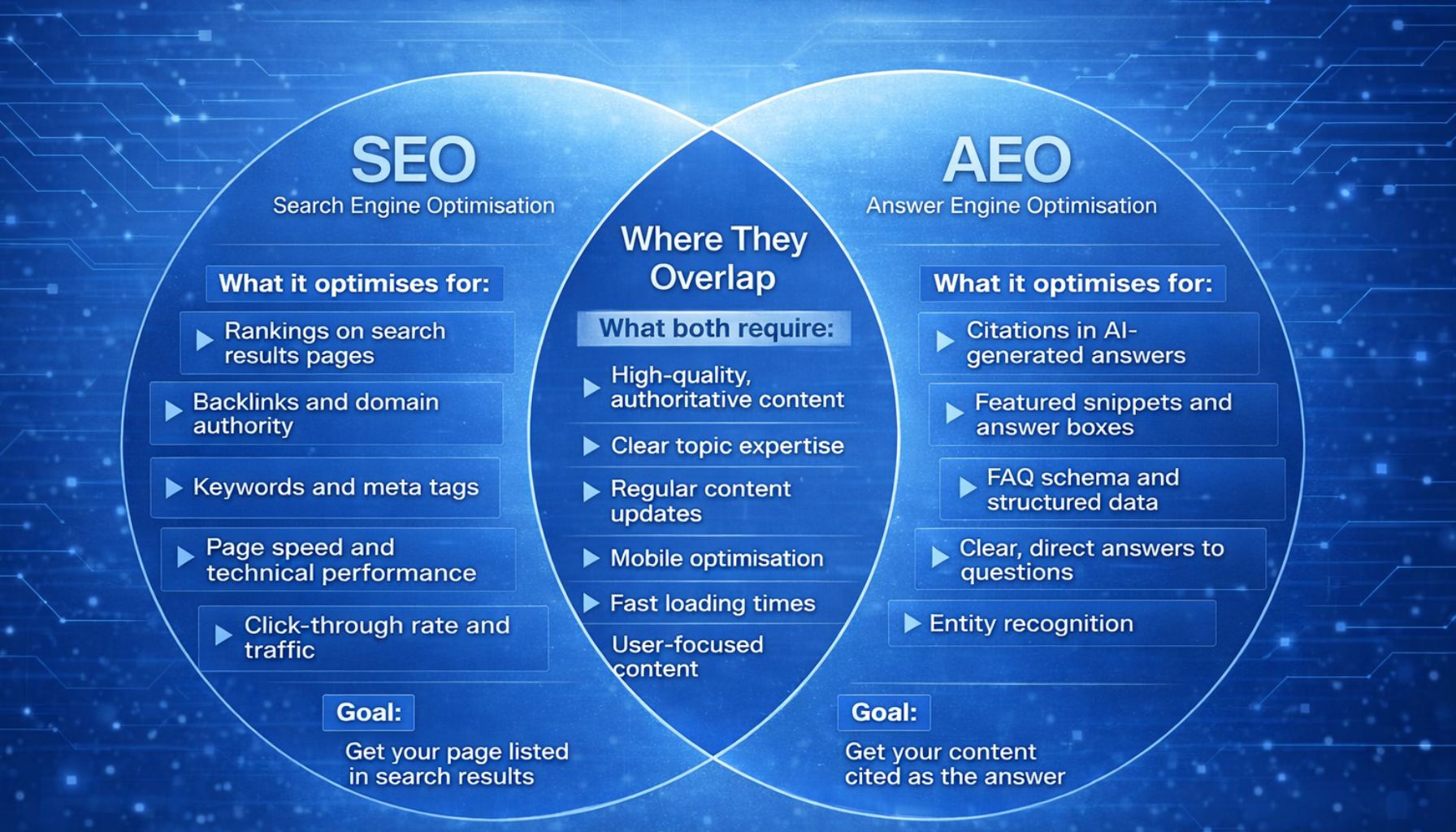
SEO is about climbing rankings. AEO is about showing up in direct responses, AI summaries, voice assistant replies, and featured snippets. They're not competing with each other. They're just solving different parts of the same puzzle.
Simply put:
-
SEO optimises content for search rankings
-
AEO optimises content for AI-generated answers
Together, they shape how visible your information actually becomes across the full range of modern search environments.
How AEO Works
AEO is really about removing friction. The easier it is for an AI to read and pull from your content, the better your shot at ending up in a response. A few things drive that:
Structured answers
Content should speak directly to specific questions. Don't make someone wade through paragraphs of buildup before the actual answer appears.
Entities and context
AI systems lean heavily on entities and topic relationships to make sense of things. Spelling those relationships out clearly in your content makes it far easier to interpret.
Featured snippet optimisation
There's a real connection between featured snippets and AI-generated answers. Content formatted for snippets often becomes a source for AI responses.
Structured data
Schema markup tells search engines and AI tools what different parts of a page actually mean, whether it's a product, an event, an FAQ, or an organisation. It removes the guesswork.
Because AI search depends on structured, organised information, this stuff isn't optional anymore.
Examples of AEO Platforms
AEO targets platforms that prioritise answers over traditional search result lists. That includes:
-
AI-powered search engines
-
Voice assistants like Alexa or Google Assistant
-
AI chatbots and generative AI platforms such as ChatGPT, Copilot, and Perplexity
-
AI summaries such as Google AI Overviews
These tools hand users information right away. Often, no clicking is required.
Differences between SEO and AEO
|
Feature |
SEO |
AEO |
|
Focus |
Ranking web pages |
Providing direct answers |
|
Target |
Search engines |
AI answer engines |
|
Content Style |
Long-form optimized content |
Structured question-based answers |
|
Key Signals |
Keywords, backlinks, technical SEO |
Entities, structured data, clear answers |
|
Result Format |
Search listings |
AI-generated responses |
The core distinction is simple. SEO is about climbing search engine results pages. AEO is about ensuring your information appears in AI responses and summaries. One thing worth remembering, AEO doesn't replace SEO. It builds on the SEO foundation that's already in place.
SEO vs AEO vs GEO
As AI search has matured, a third concept has shown up: Generative Engine Optimisation (GEO). GEO is about optimising content so generative AI systems can draw from it when building detailed, multi-source explanations, the kind of response that pulls together several different perspectives rather than grabbing a single snippet.
|
SEO (Search Engine Optimisation) |
AEO (Answer Engine Optimisation) |
GEO (Generative Engine Optimisation) |
|
Focuses on ranking websites in traditional search engine results pages |
Focuses on delivering clear, direct answers to user questions |
Focuses on helping generative AI systems create detailed responses |
|
Targets traditional search engines like Google and Bing |
Targets AI-driven search tools, voice assistants, and answer engines |
Targets generative AI platforms that produce AI-generated summaries |
|
Uses keywords, backlinks, technical SEO, and on-page optimisation |
Uses structured data, entities, and question-based content |
Uses contextual information, entity signals, and topical authority |
|
Content is usually long-form and optimised for search algorithms |
Content is structured with clear questions and concise answers |
Content is comprehensive, so AI models can analyse multiple sources |
|
Users click links to access full content |
Users receive direct answers without browsing multiple sites |
Users see AI-generated explanations compiled from several sources |
|
The primary goal is to improve organic search visibility |
The primary goal is to appear in AI answers |
The primary goal is to influence AI-generated responses |
Most marketers these days are weaving SEO, AEO, and GEO together rather than treating any of them separately. The overlap is real. And the lines between them keep getting blurrier as AI search continues to develop.
How Generative Engine Optimisation Influences AI Citations
Generative AI systems work differently from traditional search engines. Rather than indexing pages and surfacing links, they pull information from multiple trusted sources and build a response from what they find. That has one big implication: websites that consistently publish authoritative content are more likely to be cited when AI summarises a topic.
A strong GEO strategy comes down to a few things, topical authority, mentions across reputable websites, and comprehensive content that actually covers a subject in depth. When AI platforms keep seeing signals of expertise and trust from the same source, they're more likely to reference it.
In practice, this means producing well-researched content, maintaining a visible brand presence across the web, and ensuring your information is structured clearly enough for AI systems to make sense of it. None of that is wildly different from a good content strategy in general. It just takes more intention.
Why AI Search is Changing SEO Strategy
Something has been happening in modern search results, and it's hard to ignore. Structured content keeps showing up in AI summaries. Pages with clear headings, concise explanations, and organised information get referenced far more often in AI-generated responses. That's not random. Combining strong SEO fundamentals with AEO-focused formatting has become one of the more reliable ways to stay visible as AI-driven search continues to expand.
Rise of AI-Powered Search Engines
Search engines have changed a lot as AI has become more central to their operation. Modern systems can interpret queries conversationally and generate summarised answers on the spot, rather than showing a ranked list of links and leaving the rest to the user. AI platforms now combine information from multiple sources into one synthesised response.
Features like Google AI Overviews make that direction pretty clear.
Search Generative Experience
Google's Search Generative Experience (SGE) introduced a very different kind of search interface. AI now provides contextual responses that appear above traditional results. This means content has to be optimised not just for rankings but also for AI interpretation and extraction. That's a meaningful shift in what it actually means to optimise for search.
Voice Search and Conversational Queries
Voice search has quietly changed expectations around what answers should look like. When someone asks a voice assistant a question, they want one clear answer, not a list to sort through. That expectation maps almost directly onto AEO principles, which is why voice search optimisation and AEO are becoming increasingly hard to separate.
How to Optimise Content for AI Search Engines
To perform well in AI-driven search, content needs to be structured clearly so both search engines and AI systems can easily understand and extract information.
Use Structured Data and Schema
Structured data gives both search engines and AI systems a clearer picture of what a page is really about. Schema markup labels key elements, questions, products, organisations, and events, so AI tools can interpret that information without guessing. It's one of the most direct ways to improve how your content performs in AI-driven environments.
Focus on Entity-Based SEO
Entity-based SEO has become more important as AI models increasingly rely on knowledge graphs to understand how topics connect. Entities help AI recognise people, organisations, locations, and concepts. Optimising content around them strengthens both SEO performance and AI comprehension.
Write Content That Directly Answers Questions
AI platforms consistently favour pages that get to the point. To improve AI visibility:
-
Provide concise answers
-
Use question-based headings
-
Explain topics clearly and directly
The faster an AI system can extract information from your content, the more useful and referenceable that content becomes.
Optimise for Conversational Queries
People search the way they talk, especially with their voice. Optimising content for spoken-style questions improves performance in voice search and AI chatbots, where conversational phrasing is completely normal.
AEO Strategy for 2026
To succeed in AI-driven search, content must be structured so AI systems can easily understand, extract, and deliver answers.
Create Answer-Focused Content
Good AEO content puts clarity first. Users and AI systems alike should be able to find the answer quickly, without having to read much background first.
Optimise for Featured Snippets
Featured snippets and AI-generated answers are closely connected. Content structured in snippet-friendly formats, short definitions, numbered steps, and direct Q&A is more likely to surface in both. It's one of the simpler ways to improve AEO visibility.
Build Authority Through Entities
AI systems tend to favour authoritative sources. Building real topical authority in your subject area strengthens credibility and improves recognition in AI-driven results over time.
Use Structured Data and FAQs
FAQ sections work particularly well for AEO because they provide AI systems with a clear map of common questions and their answers. Pair them with structured data, and they become even more useful.
SEO Strategy for AI Search Optimisation in 2026
Modern search requires a strategy that works for both traditional search engines and AI-driven platforms.
Combine SEO and AEO
Running SEO and AEO together, rather than picking one, tends to get the best results. SEO drives visibility in traditional search engines. AEO helps content appear in AI-generated answers. Done well, they reinforce each other.
Focus on Topical Authority
Search engines and AI systems both reward expertise. Publishing comprehensive topic clusters, groups of content that approach a subject from multiple angles, is one of the more reliable ways to build the kind of topical authority that both traditional and AI-driven search will recognise.
Optimise for AI Search Rankings
Modern SEO strategies have to account for both search engine algorithms and AI interpretation. These aren't the same thing, but they're getting harder to separate as AI plays a bigger role in how search results come together.
Build Content Clusters
Content clusters help search engines and AI systems understand how topics relate to each other. That clarity strengthens overall search visibility, both in traditional results and in the AI-generated responses that keep appearing above them.
Strengthen Brand Signals Across the Web
Generative AI systems tend to lean toward sources they see consistently. Websites that appear regularly across industry publications, directories, and authoritative content platforms are treated as more reliable, and therefore more worth citing.
Building brand mentions, earning backlinks from reputable websites, and putting high-quality content out across multiple platforms all feed into those trust signals. It takes time. But it compounds. Over time, it raises the likelihood that AI systems will reference your content when answering questions in your area of expertise.
Future of SEO and Answer Engine Optimisation
AI will keep changing how people search. That much is certain. But the idea that SEO is becoming obsolete misses something important, AI platforms still depend on high-quality web content to generate their answers and summaries. Content that ranks well tends to be cited. That dependency isn't disappearing.
AEO and SEO aren't on a collision course. They're developing in parallel, both becoming more important as AI search grows. Businesses that build a strong SEO foundation while adapting to AI-driven search will be in a much better position for whatever comes next.
SEO vs AEO vs GEO – Which Matters Most in 2026?
Honestly, it's the wrong question. SEO, AEO, and GEO aren't competing priorities. They're different layers of the same strategy.
SEO is still the foundation. Search engines still depend on quality web content to determine what's relevant and authoritative. That hasn't changed. AEO builds on that foundation by structuring content so AI systems can pull clear answers for summaries and voice search. GEO goes one step further by helping generative AI platforms identify and cite reliable sources when crafting longer, more detailed responses.
The smartest approach in 2026 combines all three, strong SEO fundamentals, answer-focused content for AEO, and authoritative, comprehensive content that supports GEO visibility. Each layer makes the others stronger. Treating any one of them as optional means leaving visibility on the table.
Frequently Asked Questions (FAQs)
Is AEO replacing SEO?
No, AEO is not replacing SEO. Traditional SEO still builds the foundation for search visibility, while AEO helps content appear in AI-generated answers and summaries.
Why is AEO important for AI search?
AEO helps AI platforms quickly understand and extract information from content. As AI-powered search tools provide direct answers, optimising for AEO improves visibility in those responses.
What are AI Overviews in search results?
AI Overviews are AI-generated summaries that appear at the top of search results. They combine information from multiple sources to give users a quick answer without requiring multiple clicks.
How can you optimise content for AI search engines?
To optimise for AI search, create clear answers, use structured headings, add schema markup, and focus on entity-based SEO. Content that is easy to understand performs better in AI-driven search.
What is generative engine optimisation (GEO)?
Generative Engine Optimisation focuses on optimising content so generative AI systems can use it when producing detailed responses. It helps influence how AI summarises and explains topics.
Does voice search affect SEO strategy?
Yes, voice search changes how people search by using conversational queries. Optimising for voice search means creating clear, question-based content that provides quick answers.
Will SEO still matter in the future of AI search?
Yes, SEO will remain essential because AI systems rely on high-quality web content as their source of information. Strong SEO fundamentals still help content gain authority and visibility.