 ChatGPT
 Claude
 Grok
Grok Perplexity
 Gemini
Search doesn't work the way it did even two years ago. Ranking on Google used to be the whole game. Now showing up inside a ChatGPT answer, an AI Overview, or whatever your phone's voice assistant reads back to you matters just as much, sometimes more.
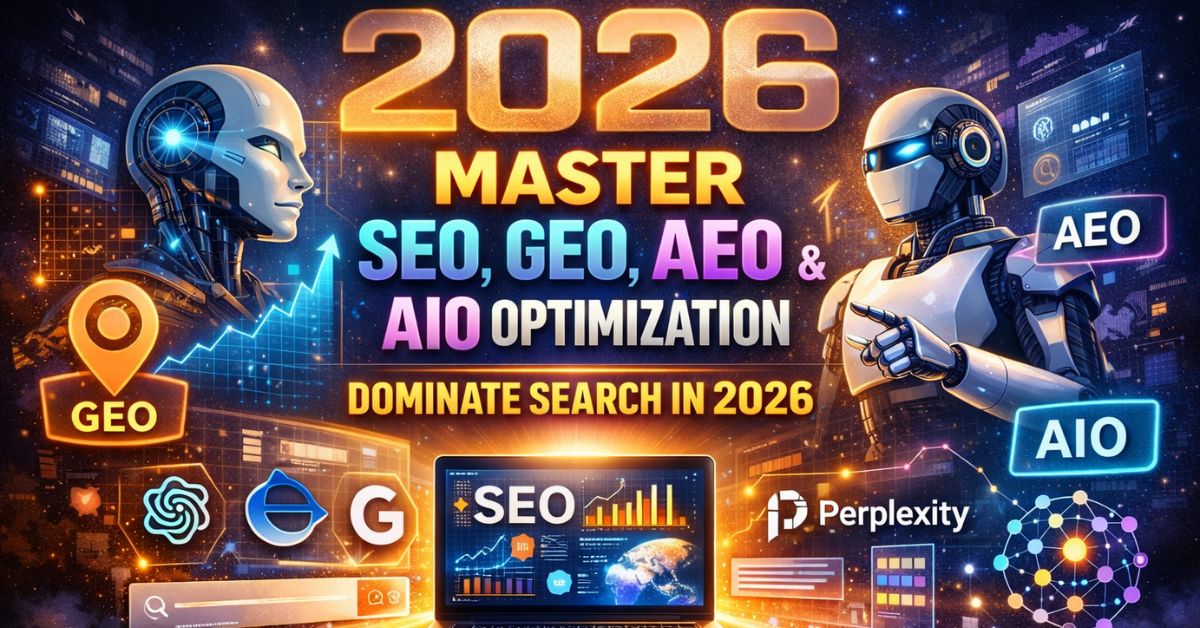
Here's the shift I keep seeing with clients: people used to type a query, scan ten blue links, and pick one. Now they ask a question and expect an answer, full stop. No clicking around. That's the whole reason four acronyms have taken over every marketing conversation this year - SEO, GEO, AEO, and AIO.
I'll be honest, half these terms get thrown around loosely by agencies trying to sound cutting-edge. So let's actually break down what each one means, where they overlap, where they don't, and how to build a strategy that works across search engines and AI platforms without treating them as four separate jobs.
What Do SEO, GEO, AEO & AIO Actually Mean?
Think of these as four layers stacked on top of each other, not four competing strategies:
-
SEO (Search Engine Optimization) - the old-school work of ranking on Google and Bing. Keywords, backlinks, page speed, mobile experience. Nothing about this has gone away.
-
GEO (Generative Engine Optimization) - getting your content picked up and cited inside tools like ChatGPT, Gemini, and Perplexity.
-
AEO (Answer Engine Optimization) - winning featured snippets, answer boxes, and the zero-click results where the engine answers the question right there without sending anyone to your site.
-
AIO (AI Optimization) - the broader work of structuring your content, schema, and site so AI models can actually parse it and trust what they're reading.
I want to be clear about one thing up front: none of these replace SEO. I've had clients ask me to "just do GEO instead" and that's not really how it works - it's more like GEO and AEO sit on top of a technically sound SEO foundation. Skip the foundation and there's nothing for the AI layer to build on.
Why Traditional SEO Still Carries the Whole Thing
AI tools aren't pulling answers out of thin air. ChatGPT, Gemini, and the AI Overview box in Google are all drawing from indexed, reasonably well-optimized websites somewhere underneath. So the basics - keyword relevance, backlinks, a site that loads fast, content that's actually structured, still decide whether you're even in the running to get cited.
If your site isn't technically sound or isn't ranking to begin with, your odds of appearing in an AI-generated answer drop sharply. A quick SEO wins approach fixing internal linking, cleaning up redirects, and tightening title tags is often the fastest way to build that foundation before layering on GEO or AEO tactics.
How GEO, AEO & AIO Actually Decide What Gets Shown
Here's where it gets different from classic ranking. AI engines don't rank ten pages and let you pick, they read a bunch of sources, decide what's actually useful, and summarize it into one answer. That's a completely different game than "get to position one."
GEO rewards content that's easy to lift out and quote: clear headings, the direct answer stated early instead of buried in paragraph four, facts that can actually be verified against something.
AEO rewards short, tight paragraphs that answer one specific question well; the same formatting that used to win featured snippets is now winning voice search results too.
AIO is the widest net of the three. It's less about one page and more about whether your schema markup, your entity relationships, and your overall site authority let an AI system understand your brand's context everywhere, not just on the page it happens to be reading.
Quick Comparison: SEO vs GEO vs AEO vs AIO
|
Discipline |
What It's Really About |
Where You Win |
|
SEO |
Links and rankings |
Classic organic search results |
|
GEO |
Getting cited and summarized |
ChatGPT, Gemini, Perplexity responses |
|
AEO |
Owning the best-formatted answer |
Snippets, answer boxes, zero-click |
|
AIO |
Being readable and trustworthy to AI |
Voice assistants, AI-led discovery |
SEO vs GEO: Two Different Environments, Same Authority
SEO still drives traffic the way it always has rank higher on Google or Bing, getting more clicks. GEO is a different environment entirely, because there often isn't a click to win. The user gets a synthesized answer and moves on.
But here's the connection people miss: backlinks and brand mentions haven't stopped mattering just because GEO exists. They're still the authority signal GEO just applies that same signal toward a different outcome. Instead of chasing position one, you're chasing a spot inside the AI Overview or the generative response itself. Search is sliding from "here's a list of links, go pick one" toward "here's your answer", and GEO is basically the bridge between those two worlds.
AEO vs AIO: Winning the Answer vs. Being Understood Everywhere
AEO is the narrower of the two, win the answer box, win the snippet, win the zero-click spot. AIO is the bigger picture: how your entire content ecosystem holds up across every AI assistant and voice platform out there, not just one search result.
Voice search leans hard on structured data and short, direct phrasing, which is really AIO's job more than AEO's. Put simply: AEO gets you the answer. AIO makes sure the rest of your site is legible enough for whatever system is delivering that answer to trust the source behind it.
Building a Strategy That Actually Covers All Four
Winning across all four means you stop optimizing single keywords in isolation and start thinking in terms of a connected content system.
Keyword and content strategy. Matching user intent now beats matching exact-match keywords. Write direct answers, structure your paragraphs around logical headings instead of stream-of-consciousness, and think about how someone would actually phrase a question out loud to an AI assistant, it's rarely the same phrasing they'd type into Google.
Backlinks and authority signals. Backlinks still carry real weight with Google, that hasn't changed. What has changed is that brand mentions, even unlinked ones, are starting to register as trust signals with AI models too. And strengthening internal links between related pages does double duty: it tells Google you cover a topic thoroughly, and it gives AI crawlers the same signal.
Regional and international targeting. If you're serving more than one market, this same GEO-style thinking applies at the country and city level too. Building out dedicated hubs, an international SEO strategy page, a Texas SEO services page, a London SEO services page and linking each one back to a global pillar page helps both Google and AI engines understand your geographic authority instead of guessing at it.
Topical authority. Publishing connected, genuinely deep content around one core subject beats scattering one-off posts across a dozen unrelated topics. It's one of the fastest ways to earn AI citations without leaning entirely on backlinks. It's the same logic behind ranking a site without backlinks at all, consistency and depth compound whether or not Google's crawling a link profile.
How to Actually Measure This Stuff
Tracking success now means watching a few different dashboards at once, not just one Analytics view:
-
Organic traffic growth
-
Featured snippet placements
-
Zero-click visibility
-
Brand mentions showing up across the web
-
How often tools like ChatGPT actually cite your content
Snippet wins and answer-box placements tell you how your AEO is doing. Whether AI tools are quoting your brand tells you how GEO is doing. And for the traditional SEO side of the picture, Google Search Console and Bing Webmaster Tools are still doing exactly what they've always done.
Getting Ready for 2026 and Beyond
-
Keep the traditional SEO foundation solid technical health, mobile performance, site speed. None of this is optional just because AI exists now.
-
Apply structured schema markup across the whole site, not just a handful of pages.
-
Write clearly, keep it concise, and use headings that actually reflect what's in the section.
-
Build authority the old-fashioned way backlinks and brand mentions.
-
Track visibility across search engines and AI platforms side by side, not as separate reports nobody looks at together.
SEO alone isn't enough anymore. But chasing every AI trend without the fundamentals underneath it isn't a strategy either, it's just noise. The combination of SEO, GEO, AEO, and AIO working together is what actually holds up long-term.
FAQs
What's the actual difference between SEO, GEO, AEO, and AIO?
SEO ranks your content in traditional search engines. GEO gets your content cited by generative AI platforms. AEO targets featured snippets and direct answers. AIO structures everything so AI models and assistants can read it and trust it.
How do I optimize content for AI search engines?
Use clear structure, answer questions directly and early, use strong headings, keep your facts accurate, and add schema markup. AI engines favor content that's easy to lift out and summarize the opposite of a rambling, unstructured post.
Is traditional SEO still important now that AI search exists?
Yes, and it's not close. Backlinks, technical SEO, and genuinely good content are still the foundation AI search pulls from. Without that groundwork, AI visibility is much harder to earn; there's simply nothing for the AI layer to point to.
What exactly is Generative Engine Optimization (GEO)?
GEO is the practice of shaping content so it gets cited and summarized by generative AI platforms like ChatGPT, Gemini, and Perplexity rather than only competing for a ranking spot in traditional results.
What is zero-click search, and why should I care about it?
Zero-click search is when someone gets their answer straight from the search engine or AI assistant and never actually visits a website. AEO is what improves your visibility inside those zero-click formats.
How should marketers actually prepare for AI-driven search?
Keep solid traditional SEO in place, build structured and schema-rich content, keep earning authority through backlinks and brand mentions, and track performance across both search engines and AI platforms, not just one or the other.
Final Thoughts
SEO, GEO, AEO, and AIO aren't rival strategies fighting for budget. They're layers of the same visibility stack, and treating them as separate projects is how most brands waste time. The ones who keep their technical SEO foundation solid while adapting content for AI extraction are the ones who end up winning both the search results and the AI-generated answers.
Want a strategy built around this exact framework? Book a free strategy call and see where your site actually stands right now.