 ChatGPT
 Claude
 Grok
Grok Perplexity
 Gemini
Most Texas business owners hear the same line from every SEO pitch: build hundreds of backlinks and you'll rank. It's not true anymore. With the right topic cluster setup and a semantic approach to content, you can own your local market without chasing a single link.
Google's ranking system has moved on. Topical depth now carries more weight than raw link counts, and that's especially true for regional searches across Houston, Dallas, Austin, and San Antonio. Here's how topic clusters and semantic SEO actually work for Texas businesses, and how to use them to pull ahead of competitors still stuck on old-school link building.
1. Why Texas Businesses Don't Need Backlinks to Rank (Anymore)
Google's Shift Toward Topical Authority
Google's 2023 Helpful Content Update changed what "authority" means. Sites no longer win by accumulating links, they win by proving they actually understand a topic. Ahrefs' own research shows over 90% of pages get zero organic traffic, and the ones that do rank are pulling ahead through depth, not backlink volume.
That's a gift for Texas businesses. A family-run HVAC company in Plano isn't going to out-link a national chain. But it can out-explain them on something like "heat pump installation in North Texas summers," and that's where the ranking actually happens now.
The E-E-A-T Factor for Local Markets
Google's E-E-A-T model, Experience, Expertise, Authoritativeness, Trustworthiness, rewards content written by people who've actually done the work. A Texas roofer covering hail damage repair in DFW brings on-the-ground knowledge a national blog can't fake. Google reads that as relevance, and none of it requires a backlink to communicate.
NEW: Google's Local Pack and the 3-Pack Advantage
Search "plumber near me" or "Austin divorce attorney" and Google puts a Local 3-Pack above the organic results. Getting into it depends on:
-
Google Business Profile completeness and correct category selection
-
Review velocity and sentiment (aim for 10+ new reviews monthly)
-
NAP consistency (Name, Address, Phone) across every directory listing
-
Local content signals on your site, not backlinks
2. Understanding Topic Clusters: The Architecture Behind Authority
What Is a Topic Cluster?
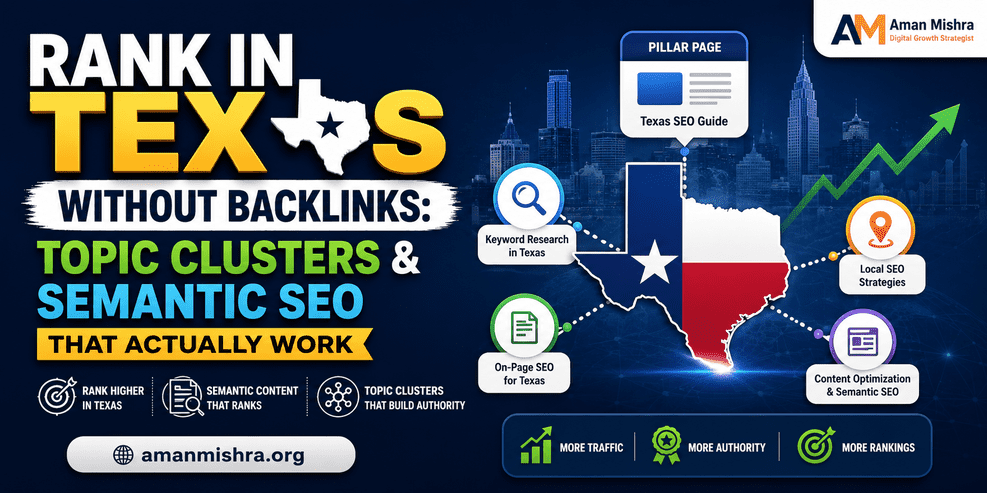
A topic cluster has three moving parts:
-
One Pillar Page: a broad, thorough overview (e.g., "Commercial Landscaping in Austin, TX")
-
Multiple Cluster Pages : focused articles on subtopics (e.g., "Drought-Resistant Plants for Austin Businesses," "Irrigation Systems for Texas Clay Soil")
-
Internal Links : connecting cluster pages to the pillar, and to each other
Picture a wheel. The pillar is the hub, the cluster articles are the spokes, and every spoke reinforces the hub. This is the same logic behind why internal linking is one of the most overlooked SEO wins most sites leave on the table.
Why Topic Clusters Work Without Backlinks?
Cover every angle of a topic across your cluster and Google's crawlers start treating your site as a complete resource, not a single page competing on its own. That topical completeness does the same job backlinks used to do. HubSpot, one of the companies that popularized this model, saw a 30% jump in organic traffic after restructuring around it.
Topic Cluster Examples by Texas Industry
|
Industry |
Pillar Page Topic |
Sample Cluster Pages |
|
Real Estate |
Buying a Home in Austin, TX |
First-Time Buyer Programs in Travis County; Austin Neighborhood Guides; Texas Property Tax Explained |
|
Healthcare |
Pediatric Care in Houston Metro |
Choosing a Pediatrician in Katy TX; Childhood Vaccine Schedule Texas; Houston Children's Hospital vs. Texas Children's |
|
Legal |
DWI Defense in Dallas County |
Texas DWI Penalties by Offense; ALR Hearing Process TX; Deferred Adjudication for DWI in Texas |
|
HVAC |
AC Services in San Antonio |
Heat Pump vs. Central AC for Texas Homes; SEER Ratings for Hot Climates; AC Financing Options San Antonio |
|
Roofing |
Roof Replacement in DFW |
Hail Damage Claims in North Texas; Metal vs. Asphalt for Texas Heat; Best Roofers in Plano vs. Frisco |
3. Semantic SEO: Speaking Google's Language in Texas Markets
What Is Semantic SEO?
Semantic SEO is about meaning and intent, not keyword repetition. Stuffing "plumber Houston TX" across a page 40 times won't move the needle anymore. What works is covering the full concept, related terms, comparisons, questions, and context Google expects a genuine expert to include.
Google's NLP models can tell the difference between a page that actually covers a topic and one padded with keyword noise.
Building Semantic Depth: A Texas Law Firm Example
A San Antonio personal injury firm targeting "car accident lawyer" should also cover:
-
Texas fault laws and comparative negligence rules
-
How to file a claim with TxDOT or DPS
-
Statute of limitations in Texas (2 years for personal injury)
-
What "diminished value" means for Texas vehicle claims
-
Common injuries on Texas highways (I-35 corridor, Loop 410, US-281)
-
Average settlement timelines for Texas auto accident cases
None of that needs a link. It needs research and local knowledge written down properly.
Tools to Identify Semantic Terms
-
Google's "People Also Ask" : mine it for semantic subtopics in your niche
-
Surfer SEO / Clearscope : surface the NLP terms Google associates with your keyword
-
Google Search Console : find queries where you sit on page 2-3 and expand those pages
-
AlsoAsked.com : map out question clusters around a seed keyword
-
Semrush Keyword Magic Tool : filter for question-based queries to build out cluster ideas
4. Building Your Topic Cluster Strategy Step by Step
Step 1: Choose Your Core Topic (Pillar)
Pick a broad, commercially valuable topic tied to your Texas market. Aim for a pillar keyword with 500–5,000 monthly searches, wide enough to anchor a cluster, narrow enough to actually rank regionally.
Step 2: Map Your Cluster Content
Research 8–15 subtopics your audience is searching for. Each one becomes its own page:
-
Informational clusters: answer direct questions ("How long does a roof last in Texas heat?")
-
Comparison clusters : compare options ("Metal Roof vs. Asphalt Shingles for Texas Homes")
-
Local clusters : geo-specific pages ("Roof Replacement Cost in Fort Worth vs. Plano")
-
Problem/solution clusters : address pain points ("What to Do After a Hail Storm in DFW")
Step 3: Create Content with Genuine Depth
Write cluster articles at 800–1,500 words, and make sure the detail is real, not padded. Run each page through this checklist:
Cluster Content Quality Checklist
-
Does it answer a specific question better than anything currently ranking?
-
Does it include Texas-specific data, laws, or geography?
-
Does it link back to the pillar with relevant anchor text?
-
Does it cross-link to 2-3 other cluster pages?
-
Does the pillar link out to this article?
-
Is there an FAQ section with schema potential?
-
Has it been updated in the last 12 months?
5. On-Page Optimization That Amplifies Semantic Signals
Title Tags and Header Hierarchy
Your title tag should carry the primary keyword naturally. Treat your H2s and H3s as a table of contents, both for readers and for Google's crawlers reading the page's structure.
|
Element |
Best Practice Example |
|
Title Tag |
Emergency HVAC Repair in Houston, TX | Same-Day Service |
|
H1 |
Houston Emergency HVAC Repair: What to Expect |
|
H2 |
Common AC Emergencies in Houston Summers |
|
H2 |
How Much Does Emergency HVAC Repair Cost in Houston? |
|
H3 |
Freon Leak Repair Costs in Harris County |
|
Meta Desc |
Broke down in Houston heat? Our HVAC team responds same-day... |
Schema Markup for Texas Local Businesses
Structured data tells Google exactly what your content is about. Implement:
-
LocalBusiness schema with Texas city, county, and zip code data
-
FAQ schema on cluster pages (helps land People Also Ask spots)
-
Article schema with dateModified on blog content
-
Review schema to show star ratings in search results
-
Service schema on each service page in your cluster
A Dallas dental practice that added FAQ schema to its cluster pages saw click-through rate jump 47%, purely from the extra rich snippet real estate.
Core Web Vitals: The Technical Floor
Content depth doesn't matter if the site is slow. Texas sites in competitive markets need to hit:
|
Metric |
Target Threshold |
|
LCP (Largest Contentful Paint) |
Under 2.5 seconds |
|
CLS (Cumulative Layout Shift) |
Under 0.1 |
|
INP (Interaction to Next Paint) |
Under 200ms |
|
TTFB (Time to First Byte) |
Under 800ms |
|
Mobile Page Speed Score |
70+ on Google PageSpeed Insights |
If technical issues like this are dragging your rankings down site-wide, it's worth running through a structured technical audit rather than guessing at fixes.
NEW: Internal Linking Anchor Text Strategy
Generic anchor text like "click here" wastes an opportunity. For semantic SEO, anchor text should describe exactly what the linked page covers:
-
Weak: "See our roofing services" : Strong: "hail damage roof repair in DFW"
-
Weak: "Read our blog post" : Strong: "guide to AC efficiency in Texas summers"
-
Mix exact-match, partial-match, and natural-language anchors
6. Content Freshness and the Texas Local Advantage
Leverage Hyperlocal Knowledge Competitors Can't Copy
A national competitor publishing generic content has no way to replicate this. Use it:
-
Reference specific Texas landmarks, counties, zip codes, neighborhoods
-
Cite Texas-specific laws, weather patterns, building codes, market data
-
Interview local customers and embed their stories
-
Mention local events, sports teams, cultural touchstones (yes, Friday night football counts)
-
Quote local associations: Texas Association of Realtors, Texas Medical Association, TABC
Seasonal Content Calendar for Texas Markets
|
Season |
Trigger Events |
Content Opportunities |
|
Spring (Mar-May) |
Tornado/storm season, allergy season |
Storm damage prep, roof inspection checklists, allergy-friendly HVAC filters |
|
Summer (Jun-Aug) |
Extreme heat, drought |
AC maintenance guides, heat safety for workers, water conservation for landscapers |
|
Fall (Sep-Nov) |
Hurricane season tail end, back to school |
Hurricane prep for East Texas, back-to-school health content, fall home maintenance |
|
Winter (Dec-Feb) |
Rare freezes, pipe burst risk |
Pipe freeze prevention (post-Uri lessons), heating system guides, holiday event marketing |
NEW: Competitor Gap Analysis, Find Topics They're Missing
Before writing anything new, check what your top 3 Texas competitors rank for, and what they don't. Semrush's Content Gap or Ahrefs' Content Explorer will surface:
-
Questions competitors rank for that you haven't touched
-
Thin competitor content (under 500 words) you can outdo on depth
-
Local subtopics, specific cities, counties, neighborhoods, they've skipped
This is the fastest path to ranking wins with low competition, high relevance, and zero backlinks required.
7. NEW: Google Business Profile Optimization for Texas Local SEO
Why GBP Is Your Secret Weapon
Your Google Business Profile is the highest-ROI asset you have for local Texas SEO, and it has nothing to do with backlinks. A properly optimized GBP can land you in the Local 3-Pack, which sits above organic results and captures 30-40% of local search clicks.
GBP Optimization Checklist
-
Primary category is exact ("Roofing Contractor," not just "Contractor")
-
Secondary categories added for every service offered
-
Business description includes primary keyword + city name naturally
-
All service areas listed with Texas cities and counties
-
100+ photos uploaded (exterior, interior, team, before/after)
-
Google Posts published weekly with local keywords
-
Q&A section populated with your own keyword-rich answers
-
Review response rate at 100%, Google rewards engagement
-
Booking/appointment link connected if applicable
-
Products or Services section fully filled out
Review Generation Strategy for Texas Markets
Reviews are the most powerful local ranking signal that has nothing to do with backlinks. BrightLocal's research found businesses with 100+ reviews rank 2.7x higher in the Local Pack than those with fewer than 10. For Texas businesses:
-
Text customers a review link within 24 hours of service completion
-
Train your team to ask at the point of highest satisfaction
-
Set up a simple yourdomain.com/review page that redirects straight to your GBP
-
Respond to every review, positive and negative, within 48 hours
8. Measuring Success: KPIs for a Backlink-Free SEO Strategy
Track Topical Authority Growth
Domain authority and backlink count won't tell you much here. Watch these instead:
|
KPI |
How to Measure |
|
Organic impressions by cluster |
Google Search Console, filter by page group |
|
Average position for cluster keywords |
Track 90-day rolling windows, not week-to-week |
|
Pages per session from organic |
Google Analytics 4, signals cluster navigation |
|
Featured snippet wins |
Track manually or use Semrush Position Tracking |
|
Local 3-Pack appearances |
Google Business Profile Insights dashboard |
|
GBP profile views & calls |
GBP Performance tab, weekly trends |
|
Organic CTR by page |
Search Console, optimize titles/descriptions below 3% |
A Realistic Texas SEO Timeline
|
Month |
Expected Milestone |
|
Month 1-2 |
Pillar + 5 cluster pages live and indexed; GBP fully optimized |
|
Month 3-4 |
Long-tail cluster keywords enter page 1-2; GBP review count growing |
|
Month 5-6 |
Pillar page starts ranking for head terms; featured snippets appearing |
|
Month 7-9 |
Local 3-Pack appearances increasing; cluster traffic compounding |
|
Month 10-12 |
Topical authority established; pillar ranks page 1 for primary keyword |
|
Year 2+ |
Compounding organic growth; national competitors can't replicate local depth |
Conclusion: Your Competitive Edge Is Already in Texas
You don't need to outspend national brands on link-building. The Texas market rewards businesses that actually know their territory, and a well-built topic cluster paired with semantic SEO is how you prove that to Google at scale. This is also exactly why most small businesses waste their SEO budget chasing link packages instead of building content that connects to real business goals.
Here's the action plan:
-
Choose one pillar topic this week, pick the service that generates the most revenue for your business
-
Map 8-12 cluster articles using Google's PAA boxes and Semrush
-
Fully optimize your Google Business Profile, it's free and works fast
-
Publish two cluster articles per week, consistency beats perfection
-
Add FAQ schema to every cluster page to capture featured snippet real estate
-
Track progress in Google Search Console and mark every new page-1 entry