 ChatGPT
 Claude
 Grok
Grok Perplexity
 Gemini
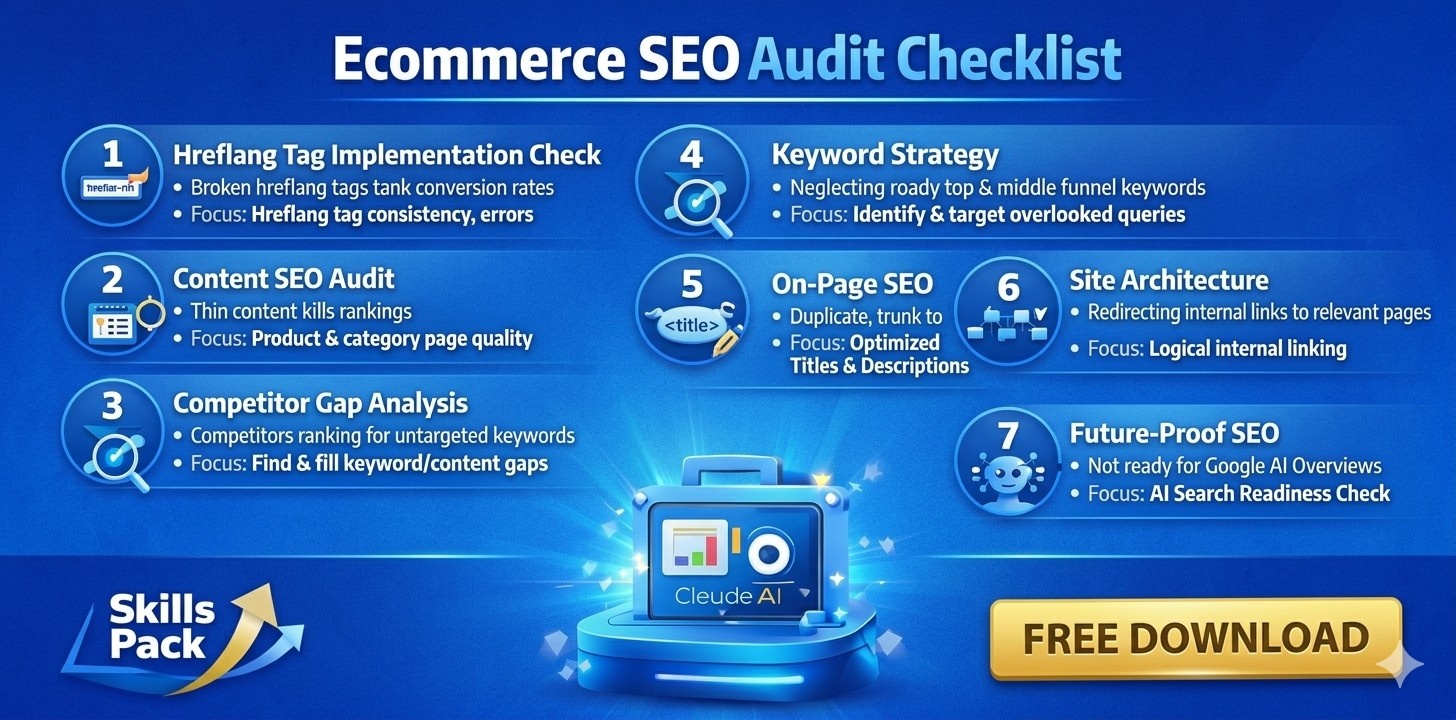
Every week we audit online stores selling across multiple markets. And every audit follows the same proven process, from fixing broken hreflang tags to checking AI search readiness. Here's the entire workflow, open-sourced.
→ Get the Full Skills Pack
Why we built this checklist: After running hundreds of ecommerce SEO audits, we noticed the same problems appearing every single time. So we turned the entire repeatable process into a Skills Pack powered by Claude AI - and this blog is the full breakdown of every step.
1. Hreflang Tag Implementation Check
⚠ THE PROBLEM
Almost every multi-market store we audit has broken hreflang tags. This means Google is showing the wrong country's page to the wrong audience , destroying conversion rates silently.
If you're selling in multiple countries, say the UK, US, and Australia, Google needs explicit instructions about which version of your page to show to which audience. That's exactly what hreflang tags do. But getting them right is notoriously tricky.
What We Check
1. Are hreflang tags present on all international pages?
2. Do all alternate URLs return a 200 status code?
3. Is there a reciprocal hreflang tag on each alternated page?
4. Is the x-default tag set for users outside targeted regions?
5. Are language codes using correct ISO 639-1 format (e.g. en-GB, fr-FR)? Are hreflang tags consistent across HTTP header, sitemap, and on-page?
EXAMPLE - CORRECT HREFLANG IMPLEMENTATION
<link rel="alternate" hreflang="en-gb" href="https: /store.com/uk/shoes/" > <link rel="alternate" hreflang="en-us" href="https: /store.com/us/shoes/" > <link rel="alternate" hreflang="en-au" href="https: /store.com/au/shoes/" > <link rel="alternate" hreflang="x-default" href="https: /store.com/shoes/" >
Our Hreflang Tag Generator inside the Skills Pack automates this entire process - generating the correct tags for every page across all your markets in seconds.
2. CONTENT SEO
Product & Category Page Content Audit
⚠ THE PROBLEM
Most ecommerce stores have thin, duplicate, or manufacturer-copied content on product pages. Google can't rank pages it can't differentiate, and AI search won't recommend them either.
This is the most impactful step in the audit. Product and category pages are where ecommerce stores win or lose organic traffic. Yet most stores have thin content, duplicate descriptions copied from manufacturers, or zero SEO strategy at all.
What We Check
1. Is there unique, original content on every product page?
2. Do category pages have descriptive, keyword-rich introductory text?
3. Are primary keywords used naturally in H1, first paragraph, and product title?
4. Is content thin (under 300 words) on high-priority pages?
5. Is there structured content that answers buyer questions?
6. Are product benefits, not just features, clearly communicated?
Our AI Content Audit tool reviews every page automatically, flags thin content, and gives rewrite recommendations tailored to your product category and market. It also flags content that scores poorly for AI search visibility, not just traditional Google ranking.
GEO Content: The Hidden Layer
If you sell across multiple markets, content needs to go beyond translation. A US audience searches differently than a UK audience, different terminology, different trust signals, different buying triggers. Our GEO Content Brief Generator creates market-specific content briefs so your pages feel native to each country, not just translated.
3. COMPETITIVE INTELLIGENCE
Competitor Gap Analysis
⚠ THE PROBLEM
Your competitors are ranking for hundreds of keywords you haven't even targeted yet. Every day you don't know about these gaps is a day they're capturing your potential customers.
One of the fastest ways to grow organic traffic is to find the exact keywords your competitors rank for - that you don't. These aren't long shots; they're proven keywords with proven demand. Someone is already searching them. You just need to show up.
What We Analyse
1. Keywords competitors rank in top 10 that you don't rank for at all
2. Category pages competitors have that your store is missing
3. Informational content driving competitor traffic (buying guides, comparisons) ✓ Featured snippet opportunities competitors hold that you could capture
4. Brand vs non-brand keyword ratio comparison
5. Seasonal and trending keywords in your niche
The Competitor Gap Analyzer maps this entire picture automatically. You get a prioritised list of keyword opportunities ranked by traffic potential and ranking difficulty, so you know exactly where to focus first.
4. KEYWORD STRATEGY
Keyword & Content Gap Discovery
⚠ THE PROBLEM
Most ecommerce stores only target bottom-of-funnel "buy now" keywords. They completely miss the top and middle of the funnel, where buying decisions are actually made.
Competitor analysis finds what others rank for. Content gap analysis finds what nobody is ranking well for, the opportunities hiding in plain sight. For ecommerce, this usually means informational and comparison content that sits above the product page in the buyer journey.
The six Gaps We Always Find
-
Buying guides – Pages that answer questions like “What’s the best [product] for [specific use]?”
-
Comparisons – Pages that show side-by-side differences between products, like “[Product A] vs [Product B],” which helps people decide what to buy.
-
Questions – FAQ and “how-to” pages that answer common customer questions and make your store an authority in your niche.
-
Category pages – Collections of products that people want but aren’t currently on your store.
-
Long-tail content – Specific product variants or details that have low competition but high chances of selling.
-
Local content – Pages targeting your city, region, or area so local customers can find you easily.
Every content gap we find is turned into a clear, ready-to-use content plan using the GEO Content Brief Generator. This makes sure your pages are optimized for both Google and AI search from day one.
5. ON-PAGE SEO
Meta Title & Description Optimisation
⚠ THE PROBLEM
Ecommerce stores with 500+ products almost always have auto-generated, duplicate, or truncated meta tags. These are the first thing users see on Google , and they're often broken.
Meta titles and descriptions are your store's billboard on Google. They determine whether a user clicks your result or your competitor's. Yet for stores with hundreds of products, manually writing them is nearly impossible, which is why most stores use templates that produce weak, generic titles.
What We Fix
- Titles over 60 characters being truncated in search results
2. Duplicate meta titles across similar product variants
3. Missing primary keywords in title tags
4. Descriptions that don't include a clear call to action
5. Meta descriptions over 155 characters being cut off
6. Product pages using the same title as their category page
The Meta Title & Description Optimizer handles this at scale. Feed it your product data and it generates optimised, unique meta tags for every page, following proven formulas that balance keyword inclusion with click-through appeal.
The Formula That Works
For product pages: [Primary Keyword] | [Key Benefit] | [Brand Name]
For category pages: [Category] — [Number] [Product Type] | [Brand Name]
6. SITE ARCHITECTURE
Internal Linking Strategy
⚠ THE PROBLEM
Ecommerce stores are notorious for isolated product pages with no internal links — pages Google can barely find, and users can't navigate between. It's leaving massive ranking potential on the table.
Think of internal links the way Wikipedia works. Every article links naturally to related articles, creating a web of topical authority. Ecommerce stores need the same logic: product pages linking to related products, category pages linking to buying guides, blog content linking back to relevant category pages.
What We Map
a. Orphaned pages with no internal links pointing to them
b. Category pages that aren't linking to relevant blog content
c. Blog posts that don't link back to relevant product or category pages
d. Product pages missing "related products" links
e. Pages with too many internal links (diluting link equity)
f. Anchor text diversity - over-optimised vs natural distribution
The Internal Linking Strategy Builder maps your entire site structure and generates a prioritised linking plan. It identifies which pages need more internal authority, which pages can pass it, and what anchor text to use for each link.
7. FUTURE-PROOF SEO
AI Search Readiness Check
⚠ THE PROBLEM
ChatGPT, Google AI Overviews, and Perplexity are now answering product questions directly, without users ever clicking. If your store isn't structured for AI search, you're invisible in the fastest-growing discovery channel.
This is the newest, and most important , step we've added to the audit process. In 2024 and beyond, a growing percentage of product searches happen through AI assistants. Shoppers are asking "what's the best waterproof hiking boot under £100?" and getting a direct answer. The stores that appear in those answers are the ones built for AI search.
What We Check for AI Readiness
1. Is structured data (Schema markup) implemented on product and review pages? 2. Does content directly answer common buyer questions in clear language?
AI Overview: Ecommerce SEO Audit
Ecommerce SEO audits identify technical issues, content gaps, and ranking opportunities across international markets. The audit focuses on fixing hreflang tags, improving product and category content, analyzing competitors, discovering new keywords, optimizing meta tags, improving internal links, and preparing content for AI search engines. Stores that address all seven areas rank higher in Google, appear more often in AI Overviews, and convert more customers across every market.
FAQ
1. What should be included in an ecommerce website audit checklist?
A complete ecommerce website audit checklist includes technical SEO, content quality, keyword coverage, on-page optimization, internal linking, and conversion factors. Key items to review are site speed, mobile usability, hreflang tags, structured data, product page content, meta titles, broken links, and competitor keyword gaps. These elements ensure your store ranks well and converts traffic into sales.
2. How do you perform an ecommerce SEO audit?
To perform an ecommerce SEO audit, start by crawling the site to identify technical issues. Then check product and category page content, review meta tags, analyze competitors, assess internal linking, and validate structured data. For multi-market stores, review hreflang tags and GEO-specific content. Finally, evaluate AI search readiness to ensure the site appears in AI Overviews and assistant-based search results.
3. What is included in a Shopify SEO audit?
A Shopify SEO audit checks for duplicate content, thin product descriptions, missing collection text, improper redirects, slow page speed, and weak meta tags. It also reviews app-generated scripts, broken internal links, structured data, and Shopify’s default URL structure. The goal is to optimize collections, product pages, and site architecture so Shopify stores can rank higher and load faster.