 ChatGPT
 Claude
 Grok
Grok Perplexity
 Gemini
An SEO silo structure organizes a website by grouping related content into distinct topic sections, with pages inside each section linking heavily to each other and rarely to unrelated topics. It signals topical authority to search engines and makes ranking for a whole subject far easier than scattering related pages across the site.
Most of the sites I audit don't have a content problem; the writing is usually fine. What's missing is structure. You can publish genuinely good, well-optimized articles and still watch them sit on page three, because the pages aren't clearly connected and topics bleed into each other with no real boundary. In 2026, search engines care as much about how content is arranged as what's written on each page, how things link together, and whether topics form something coherent. A silo fixes that: each topic gets its own section, and every page inside links deliberately to the others, making the site easier to crawl and building real topic authority instead of a pile of disconnected posts.
What Is an SEO Silo Structure?
An SEO silo structure is a way of organizing your site into tightly related thematic groups — silos, if you want the technical term. Each silo revolves around one core topic and typically includes:
-
One comprehensive pillar page
-
Several supporting cluster pages
-
A deliberate, controlled internal linking pattern
Instead of publishing whatever comes to mind and hoping it all connects eventually, you're building a hierarchy where related pages actively reinforce each other.
Get this right and you end up with three things: clear topical authority, efficient crawl paths, and internal link equity that's consolidated instead of scattered. Search engines read that structure as genuine subject expertise not because you told them you're an expert, but because the architecture proves it.
Physical vs Virtual Silos
There are two main ways to build a silo.
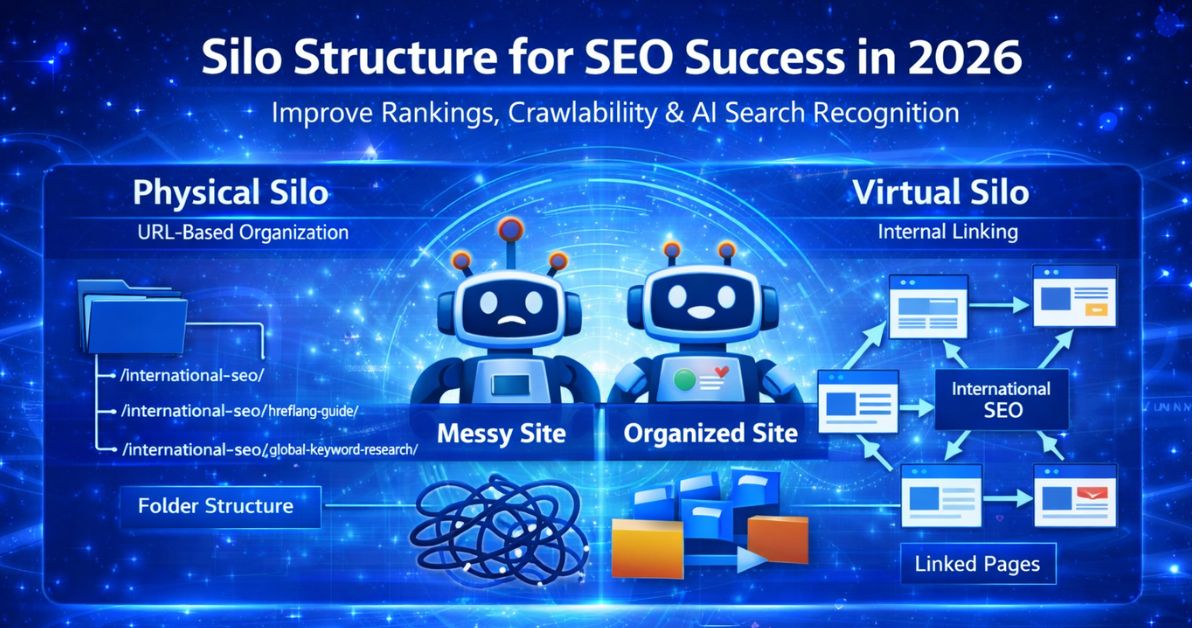
1. Physical Silo Structure (URL-Based)
A physical silo uses your actual URL folders to group related topics. It tells search engines and users how your content is organized just by looking at the address bar.
For example:
-
example.com/international-seo/
-
example.com/international-seo/hreflang-guide/
-
example.com/international-seo/global-keyword-research/
The URL path itself tells the story. Your content hierarchy is visible, not just to people scanning a link but to crawlers reading your site map. Breadcrumbs line up naturally with how the pages are nested, and search engines get an unambiguous picture of where each page sits in the bigger structure.
If you're running a large site an ecommerce store with hundreds or thousands of product and category pages, say this is usually the structure that holds up best over time.
2. Virtual Silo Structure (Internal Linking-Based)
A virtual silo skips the folder structure entirely and relies on internal links to connect related content instead.
For example:
-
example.com/hreflang-guide/
-
example.com/global-keyword-research/
If both of those pages link consistently back to an "International SEO" pillar page, they function as a silo even though the URLs don't show it. The links themselves are doing the work of communicating structure.
This approach is good for:
-
Building internal linking structure without touching URLs
-
Grouping topics on a site where changing folder structure isn't realistic
-
Expanding content flexibly
-
Getting a silo running quickly on a site that already exists
It tends to work best for blogs and content sites anywhere restructuring the URLs isn't practical.
Why an SEO Silo Structure Improves Rankings
Here's the short version: a silo makes your site clearer and more organized. When search engines understand your site better, they trust it more. And that trust shows up as better rankings.
A well-built silo strengthens four ranking factors in particular.
1. It Builds Topical Authority
Google doesn't look at one page in isolation and decide you're an expert. It looks at the whole picture how much content you've got around a topic, how those pages relate to one another and whether the entire cluster actually makes sense together.
That's where silos earn their keep. When you group pages around one core subject and link them intentionally, you're sending a clear signal: you're not just touching on this topic, you're covering it. The relationships between pages show depth. The internal links show structure. Put together, it tells Google something close to, "this site actually knows what it's talking about."
Compare that to a blog that jumps from SEO tips to cooking recipes to fitness advice with no throughline. There's no focus. No depth. Nothing that earns trust.
A silo does the opposite: it makes your site look like the go-to resource on a specific subject. And that's exactly what search engines want to reward: real, focused expertise instead of surface-level content scattered across a dozen unrelated topics.
2. It Consolidates Link Equity
Every backlink pointing at your site carries some weight. But if your pages are scattered around with no real structure, that weight leaks out in every direction and nothing gets the full benefit.
A silo fixes that. Your pillar page earns the backlinks, then passes authority down to the closely related pages underneath it. Those supporting pages link back up to the pillar in turn, and you end up with a closed loop of relevance within one topic area.
So instead of one random page getting a small boost, the entire topic section climbs together. That's how you build real ranking strength not page by page, but as a group.
3. It Improves Crawl Efficiency
Google doesn't have unlimited time to crawl your site. Crawl budget is a real constraint, and it matters more than most people assume, especially on larger sites.
When there's no clear structure, bots end up wandering. They go too deep into dead-end pages, skip over the ones that actually matter, or burn through their crawl budget before they even reach half your content. A technical SEO cleanup usually surfaces exactly how much of a site's crawl budget is being wasted this way.
With a silo in place, that changes. Pages sit closer to the surface. The paths between them are short and logical. Nothing is buried five or six clicks deep where nobody human or bot is realistically going to find it. The result: pages get discovered faster, indexed sooner, and ranked more consistently. Clean structure means efficient crawling. It really is that simple.
4. It Improves AI Search Recognition
AI-powered search doesn't work the same way traditional Google search does. Tools like AI Overviews, ChatGPT, and Perplexity aren't just matching keywords; they're trying to actually understand what your content covers, how it connects, and whether it's worth pulling into an answer. And they're picky about what they choose.
These systems favor content organized in a way they can break down easily: headings that actually describe what follows, related ideas sitting next to each other instead of scattered across random pages, and obvious connections between subtopics that show a subject has been covered thoroughly.
A silo hands all of that to them on a plate. When your pages are grouped tightly around one subject with logical links between them, AI tools don't have to guess what your site is about. They can pull the right information quickly, connect your ideas without confusion, and trust that your content is reliable enough to cite.
Now flip that around. A site with no structure, random topic jumps, and pages that barely relate to each other? AI systems will move right past it. There are too many better-organized options out there to bother untangling a mess.
If you want your content showing up in AI-generated answers and not just traditional search results, structure matters more than it ever used to. Silos give AI tools exactly what they need to find you, understand you, and actually feature you.
SEO Silo vs Topic Clusters vs Content Clusters
These three terms get used interchangeably a lot, and I get why they all help with SEO. But they're not quite the same thing. They operate at different levels.
|
Model |
Focus |
Purpose |
|
SEO Silo Structure |
Site architecture |
Organizes the website's hierarchy |
|
Authority building |
Pillar page plus supporting pages |
|
|
Content Clusters |
Keyword mapping |
Long-tail keyword grouping |
An SEO silo organizes your whole site. Topic clusters sit inside silos, built around one main page and its supporting pages. Content clusters group related keywords to guide what you actually write. When all three work together, your site ends up clear, focused, and genuinely stronger in search.
How to Build a Proper SEO Silo (Step by Step)
Building a silo isn't hard, but it does need a plan. A lot of sites skip this step they publish content first and try to organize it afterward, which almost always leads to a messy structure and weak rankings down the line.
A strong silo starts with deciding your main topics before you write a single page around them. Follow these steps in order.
Step 1: Define Your Core Topics
Start by choosing 3–6 main themes that actually match your business goals. An SEO consultancy, for example, might pick:
-
Technical SEO
-
E-E-A-T & Trust Signals
Each of those becomes its own silo. Keep the topics broad but clear, and make sure they match what your audience is actually searching for don't build a silo around one narrow keyword. Build around strong, long-term themes instead.
Step 2: Map Keywords and Subtopics
Once your main topics are set, break each one into smaller ideas. Every silo needs one main pillar keyword and roughly 8–20 related long-tail keywords underneath it.
Here's what that looks like for an International SEO silo:
|
Content Type |
Target Keyword |
URL |
|
Pillar Page |
International SEO strategy |
/international-seo/ |
|
Cluster Page |
hreflang implementation guide |
/international-seo/hreflang-guide/ |
|
Cluster Page |
geo-targeting SEO |
/international-seo/geo-targeting/ |
|
Cluster Page |
global keyword research |
/international-seo/global-keywords/ |
The pillar page gives the full overview. Cluster pages go deeper into the individual pieces. Together, that's a genuinely strong content group.
Step 3: Use a Logical URL Structure
Your URLs should reflect the structure you just built.
A bad URL looks like example.com/blog-post-123. A good one looks like example.com/international-seo/hreflang-guide/.
The second version clearly shows the main topic, the subtopic, and exactly where the page belongs. That helps both search engines and actual humans. If you're changing old URLs to fit this, use 301 redirects so you don't lose the link value you've already earned.
Step 4: Apply Strict Internal Linking Rules
Internal linking is what actually connects your silo. Without it holding things together, the whole structure falls apart. A few rules I stick to:
-
The pillar page links to every cluster page underneath it
-
Every cluster page links back up to the pillar
-
Cluster pages can link to each other when it's genuinely relevant
-
Don't link randomly across unrelated silos if you need to, link only to that other silo's main pillar page
That keeps each topic clean and self-contained.
Step 5: Audit and Maintain It
Silos need regular upkeep. Over time you'll add pages that don't quite fit, and small cracks start to show. Watch for orphan pages, broken links, pages buried too deep in the structure, weak anchor text, and links that cross silos when they shouldn't.
Tools like Screaming Frog, Ahrefs, Semrush, and Sitebulb are genuinely useful here for catching these issues before they compound. Keep the structure clean as the site grows. It's a lot easier to maintain than to fix after the fact.
How to Apply Silo Structure on an Ecommerce Site
Online stores often carry a huge number of products, and if those products aren't grouped clearly, search engines get confused fast. A silo structure keeps similar products together, which makes the store easier to understand for shoppers and crawlers alike.
Start by turning each main product category into a pillar. If you sell electronics, clothing, and home appliances, each of those needs its own main page that actually explains the category in plain language and links out to every related section. Don't leave category pages thin or empty, give search engines something to work with.
From there, place subcategories under the right main category. Smartphones and laptops belong under electronics, for instance. That alone shows a clear structure and helps search engines understand how the products relate to each other.
Add helpful guides inside the same category too buying guides, comparison posts, anything that helps a shopper decide. Those pages should link back to the main category, which builds strength for the whole section rather than just one isolated product.
Finally, make sure everything actually links properly: category pages to subcategories, subcategories back to the main category, product pages to their category. Avoid linking randomly across different product types that just weakens the whole structure. Done right, this setup helps category pages rank better, makes products easier to find, and keeps crawl paths efficient as the store grows.
Entity-Based SEO and Knowledge Graph Reinforcement
SEO in 2026 isn't just about keywords anymore. Search engines increasingly focus on entities, a brand, a topic, a product, an idea and how those entities connect to each other. They're looking at topic relationships, brand connections, and overall subject coverage.
That means your site needs to show clear links between related ideas, not just individually optimized pages. A silo structure helps directly with this. Grouping related pages together makes those relationships obvious, and pages inside one silo reinforce the same core topic with consistent signals.
Instead of scattered keyword targeting, your site presents a complete topic system that search engines can connect to their knowledge graph. When that clicks into place, your brand and your topics become easier to recognize and easier to trust.
Silo Structure and E-E-A-T Signals
E-E-A-T stands for Experience, Expertise, Authority, and Trust the signals search engines use to decide whether a site is reliable. A silo structure supports all four, honestly.
Grouping content by topic shows real experience. Covering a subject in depth shows expertise. Having many related pages connected to each other builds authority. And having everything clear and organized builds trust. When related content all lives inside one structured system instead of being scattered, the whole site looks more complete and more credible.
This matters even more for sites serving multiple countries or regions. Clear topic grouping helps build trust across different markets and audiences, which is worth its own dedicated conversation on cross-country trust signals.
Common Mistakes That Break Silo Architecture
Building a silo isn't a one-time task; you have to protect it. Plenty of sites start strong and slowly weaken their own structure over time. A few small mistakes are usually behind it:
-
Publishing content without mapping it to a silo first
-
Thin pillar pages that don't actually cover the topic
-
Over-linking across unrelated topics
-
Ignoring crawl depth
-
Letting navigation go stale
-
Skipping 301 redirects during a restructure
-
Allowing orphan pages to pile up
Even genuinely strong content underperforms if the structure behind it is weak. A silo only works if it's planned and then actually maintained.
Frequently Asked Questions
What is an SEO silo structure?
It's a hierarchical way of organizing a website that groups related content into thematic sections, connected through strategic internal linking.
How does a silo structure improve search rankings?
It strengthens topical authority, consolidates internal link equity, improves crawl efficiency, and reduces keyword cannibalization.
Does silo structure still work in 2026?
Yes if anything it matters more now, because of semantic indexing and AI-based content retrieval systems that rely heavily on clear structure.
How many pages should be in a content silo?
There's no fixed number. Competitive topics often need 10–20 supporting pages before real authority sets in.
What's the difference between physical and virtual silos?
Physical silos use URL hierarchy. Virtual silos rely purely on internal linking. Most sites end up benefiting from a mix of both.
What are the best SEO silo structure tools for website optimization?
Screaming Frog and Sitebulb are good for seeing how your pages link together and how deep they sit in the structure. Ahrefs and Semrush help with grouping keywords and spotting gaps inside a silo. Slickplan is useful for mapping the structure out before you build it. The tools help, but clear planning and disciplined internal linking still matter more than any single one of them.
Final Thoughts
SEO in 2026 isn't just about writing more content, it's about how that content is organized. Scattered pages leave search engines struggling to understand your site, no matter how good each individual piece is.
A strong silo structure keeps everything connected and clear. It helps search engines crawl your pages, understand your topics, and trust your expertise. It also makes your site far easier for AI tools to read and reference.
If your traffic feels uneven and you can't quite explain why, the problem might not be your writing at all. It might be your structure. Build the foundation first, then grow your content on top of it, and keep tightening things up as the site expands. Good structure is what turns steady effort into steady, long-term growth.